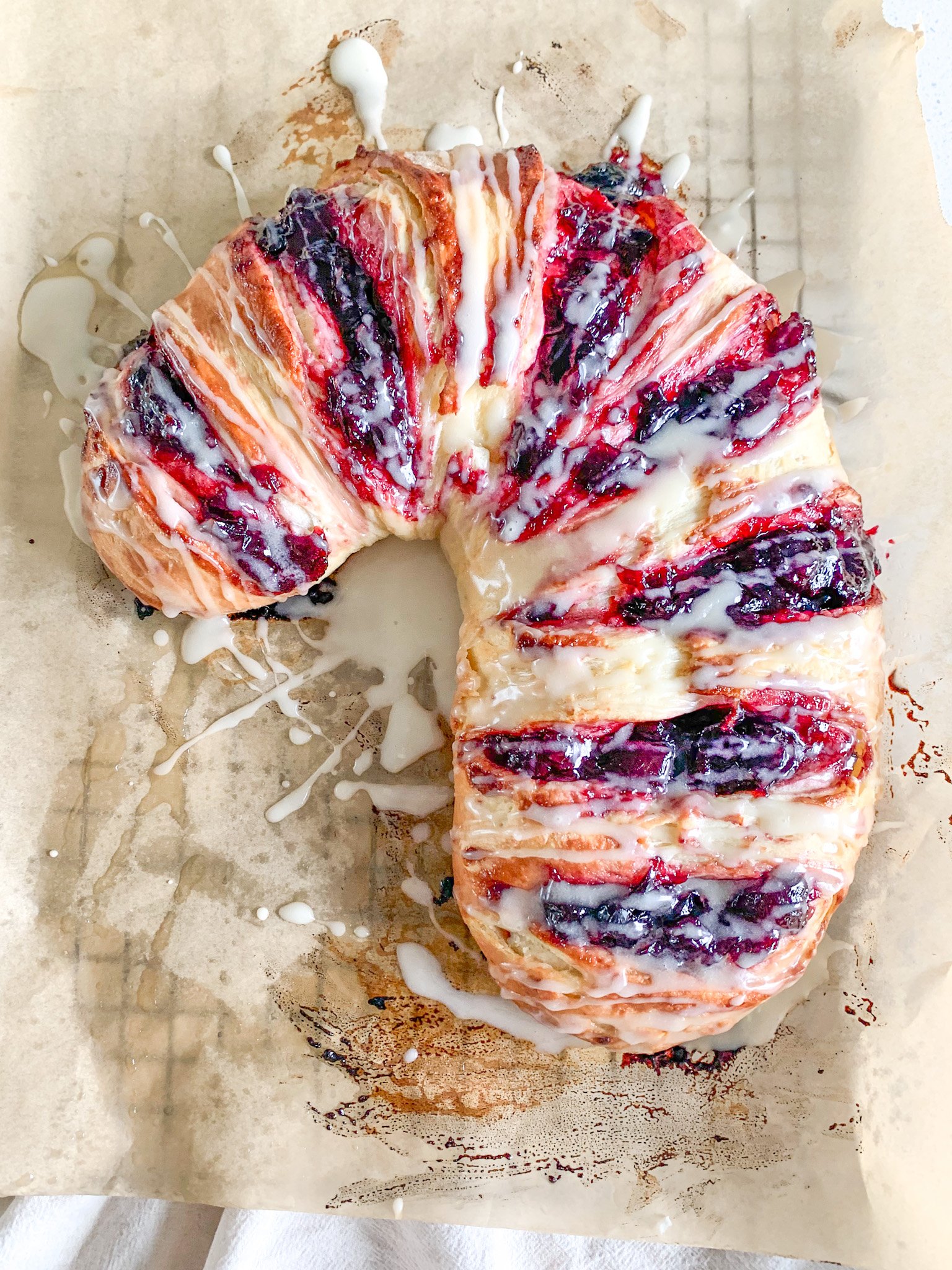
Sourdough Candy Cane Danish (Cherry-Filled)
My cherry-filled sourdough candy cane danish is the perfect breakfast for Christmas morning or St. Nicholas's Feast Day! It's got the best flaky yet fluffy dough and the perfect honey-sweetened filling. I couldn't think of a better way to kick off the holidays than a pastry shaped like a candy cane! I hope my recipe finds a special place in your kitchen this holiday season, like it has in ours!
Ingredients
Instructions
Feed Your Starter
- BEFORE YOU GET STARTED: If your starter isn't active and bubbly, feed your entire sourdough starter jar 4-12 hours before starting this recipe. I recommend feeding your entire starter a 2:1 ratio of unbleached flour to filtered water to get the same results as I do when making this recipe. (Example: Feed entire starter 1 cup flour + 1/2 cup water and let it sit on the counter at room temperature until it's bubbly and has grown in the jar. Your starter needs to be active, bubbly, and a thicker consistency to use in this recipe.)
Make Dough
- Add ONLY 1 1/2 cups of flour and 1 tsp salt to a large bowl and stir to combine.
- Grate butter into the dry mixture or use a fork to cut butter into flour until pea-sized. Stir to evenly distribute butter pieces.
- Add in milk, honey, and fed sourdough starter. Stir to combine then use your hands to finish combining into a dough ball. (If dough is too wet, your starter is more hydrated than mine. Just add a few tablespoons of extra flour. If dough is too dry, your starter is less hydrated than mine. Just add a few tablespoons of extra water.)
- Keep dough in bowl and knead for 2 minutes or use an electric mixer with a dough hook. (It’ll become a little sticky so we’re keeping it in the bowl to knead).
- Place dough back in its bowl and cover it with a damp towel or lid, loosely. Let it bulk ferment on the counter at room temperature for 12 hours or until it doubles or triples in size. Please see notes for troubleshooting.
Add Egg
- When dough has doubled in size, add egg yolk and 1/2 cup flour into dough. Knead it until well combined. (We do this after the bulk ferment for food safety)
Chill Dough
- Place dough in fridge for 1 hour (or up to 24 hours, if you want more time). Do not skip this step!
Make Filling
- While dough chills, add cherries, vanilla, honey, and lemon juice to a medium-sized saucepan and heat on medium heat for 10 -15 minutes stirring occasionally. This filling mixture should start to bubble and come together as a sauce.
- After the filling cooks, use a masher or the back of a spoon to break down the cherries into smaller pieces.
- In a small bowl, whisk cornstarch and water until combined and no lumps. Add to filling, stirring frequently until thickened over medium heat (about 2-4 minutes), remove from heat and let cool while dough finishes chilling.
Laminate Dough
- When dough finishes chilling, dust your workspace lightly with flour. Then turn it out on the countertop and roll it into a large rectangle, 1/2 inch thick.
- Grate cold butter (lamination layer ingredient) into a pile on top of the rectangle with a large holed cheese grater (or cut it into tiny pieces with a knife).
- Spread small pieces of butter into a small rectangle in the middle of dough.
- Fold top 1/3 of dough down so it folds into the middle then fold bottom 1/3 up to meet in the middle. Like an envelope. Then fold the 2 sides into the center to make a square.
- Turn dough over and roll it out into another large rectangle about 1/2 inch thick. Repeat the folding process exactly how we just did it. If the dough is sticking, dust with a little flour.
- Let rest for 2 minutes in the freezer (not on counter or in fridge!).
Shape Candy Cane Danish
- Cover a large, rimmed metal baking sheet pan with parchment paper and roll chilled dough out into a 1/4 inch large thick rectangle (about 7”x15”).
- Spread half of the cooled down cherry filling over the rolled out dough except leave an inch around all the edges so it doesn't gush out too much in the next step.
- Starting with a long side, roll dough like you would for a cinnamon roll. (If the filling starts to gush out while you do this, keep rolling then remove any excess coming out at the end.)
- Once done, carefully move log to the rimmed sheet pan covered with parchment paper so it's laying longwise. Place seam side down and tuck edges of both ends under the log.
- Take the top 1/4 and bend it to the left to make the candy cane shape.
- Take a knife and make horizontal slices half way down into the dough to make the candy cane stripes, every 1-2 inches. Add 1 spoonful of leftover filling into each of these slices to make the red stripes. Clean/wipe up any filling that may have fallen around the dough so it doesn't burn.
Proofing
- OPTIONAL: At this point you can place the pan in the fridge, covered with parchment paper, up to 24 hours if you want to make this ahead or need more time. Add 2 hours to the proofing time since the dough will start out cold.
- Cover pan loosely with a piece of parchment paper and let rise for 2 hours at room temperature on the counter top. It will be slightly puffy when ready to bake.
Bake Danish
- Preheat oven to 400 degrees Fahrenheit. Then bake at 400 degrees for 23-26 minutes or until fully baked. It will be golden brown and crispy.
Cool & Glaze
- While it bakes, whisk powdered sugar and milk in a bowl to make the glaze. It should be runny.
- When Danish comes out of the oven, remove it from the pan by sliding it off on the parchment paper onto a wire cooling rack. Drizzle glaze over the top and slice to enjoy!
Video
Notes
Please see blog post for all kinds of helpful tips and storage information.
2. What to do if your dough won’t double in size even in the warmer place (and your baked good is dense):
Troubleshooting Help for Bulk Fermenting & Rising…
1. What to do if your dough isn’t doubling in size during the bulk ferment and/or 2nd rise:- If your dough doesn’t look like it’s doing anything halfway through the rises, you need to place it in a slightly warmer area.
- This can be in a turned-off oven with the light on and oven door open, or you can slightly warm the oven to about 75-80 degrees Fahrenheit, then turn it off and place your dough inside with the door shut.
- Never leave the oven on, even on the keep warm setting, with fermenting dough inside. Your dough, for both rises, needs to double.
- If your dough doesn’t double even in the warmer area, there is a problem with your starter. It is too weak to ferment the dough even in a warm environment.
- To fix this, you will want to leave your starter out on the counter for 2 days and feed it every 12 hours at a 2:1 ratio of unbleached flour to filtered water.
- For example, 1 cup unbleached flour + 1/2 cup filtered (or bottled) water.
- Make sure you’re using unbleached flour and filtered or bottled water to do this. If you don’t, it will affect your starter strength. Reverse osmosis water (or any water that uses salt in the filter) can make the starter weak.
- This will strengthen the cultures in your starter to give you fluffy baked bread and treats. After the 2 days, you can go back to feeding it like usual (once a week if stored in the fridge or once a day if stored on the counter). Be sure to use the 2:1 ratio feeding from here on out.
Did you make this recipe?
Please leave a comment below or share a photo on social media! If you share a photo be sure to tag me @plumbranchhome
This recipe was developed from scratch in my kitchen by me, Molly LaFontaine, and tested many times by my husband and me to ensure success. Just like all of my recipes on Plum Branch Home. They’re created with purpose, cherished in our own home, and developed with my experiences, trial and error, and skills. NEVER AI (artificial intelligence). Here at Plum Branch Home we’re loving our families and serving God one recipe at a time!
Sourdough Baking Disclaimer
I regularly feed my sourdough starter a 2:1 ratio of unbleached flour to filtered water, this creates a 50% hydrated starter even when I use discard. If you feed your starter differently, results may vary due to a different hydration which will cause a different consistency. No matter how you feed your starter just ensure it’s a thick consistency when you use it for my recipes even if you’re using discard.
The temperature of my home/kitchen is 70°F. If your kitchen is colder, bulk fermentation and 2nd rise/proof may take longer. If it’s warmer, they may be shorter.
