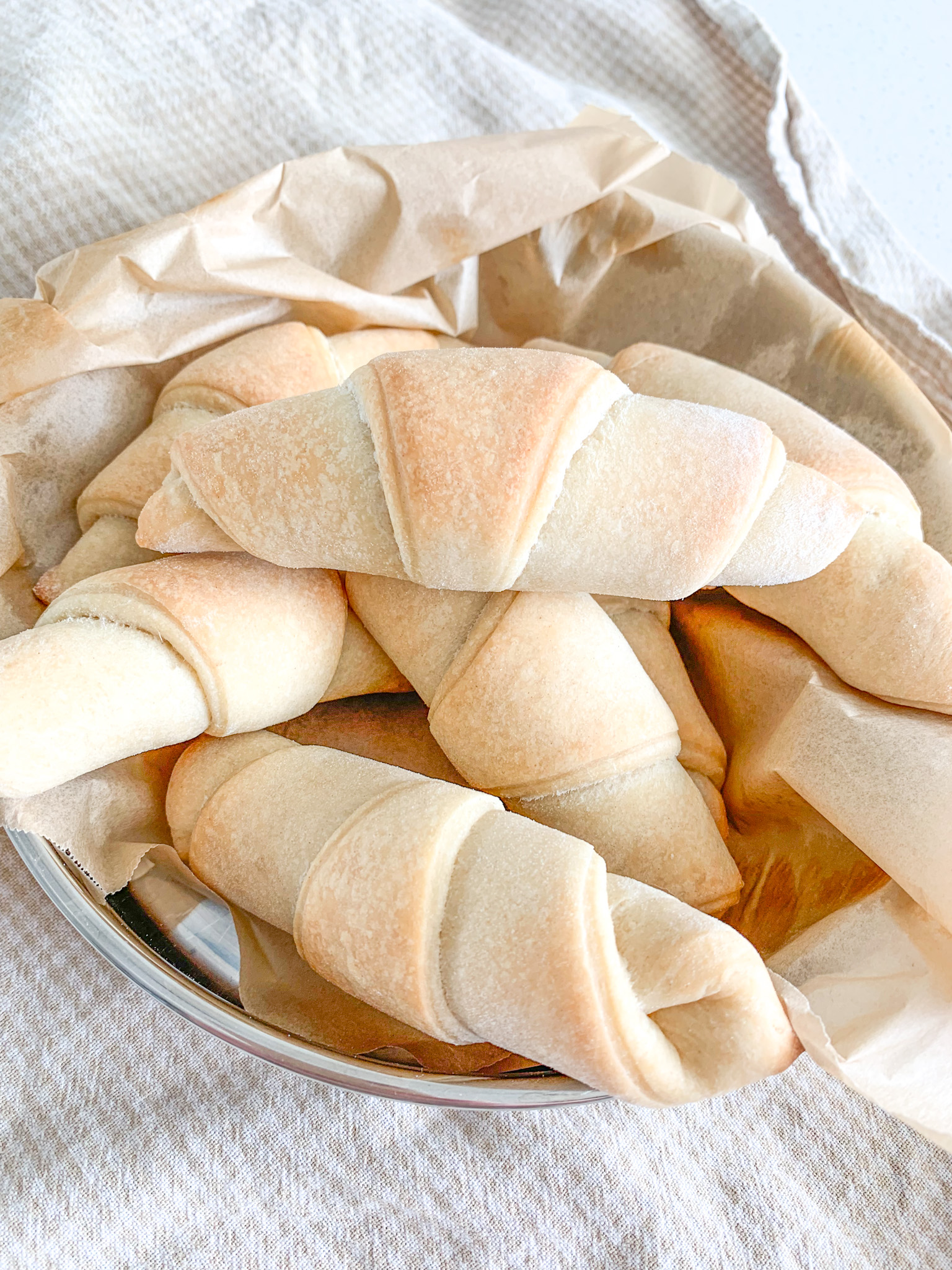
Sourdough Crescent Rolls (Better Than Canned!)
My sourdough crescent rolls are simple to make and so much better than the pre-made canned versions! I developed this recipe to replace store-bought brands, like Pillsbury, in our home. They're made with wholesome ingredients, so you don't have to worry about additives. I hope my recipe helps you make crescent rolls at home instead of buying them!
Ingredients
Instructions
Feed Your Starter
- BEFORE YOU GET STARTED: If your starter is not active and bubbly, feed your entire sourdough starter jar 4-12 hours before starting this recipe. I recommend feeding your entire starter a 2:1 ratio of unbleached flour to filtered water to get the same results as I do when making this recipe.Example: Feed your ENTIRE sourdough starter jar 1 cup flour + 1/2 cup water and let the starter sit on the counter at room temperature until it's bubbly and has grown in the jar. Your starter needs to be active, bubbly, and a thicker consistency to begin this recipe.
Make the Dough
- Add flour and salt to a large mixing bowl and stir to combine.
- Grate butter into the dry mixture or use a fork to cut butter into flour until pea-sized pieces form. Stir to evenly distribute butter.
- Add milk, honey, and sourdough starter. Stir to combine to form a shaggy dough. Use your hands to finish combining the shaggy mixture into a dough ball. (Moistness of your dough will depend on your starter's hydration. If it's not coming together, add in 1-2 Tbsp of water. If it's too wet add 1-2 Tbsp four).
- Turn the dough out on the counter and knead for 2 minutes (or use an electric mixer with a dough hook on the lowest setting).
Bulk Ferment
- Place dough back into bowl and cover it with a damp towel, Saran wrap, or a lid loosely. Let dough sit on the counter at room temperature to bulk ferment for 12 hours or until doubled in size. (Since it’s a small amount of enriched dough, it won’t bubble up and fill the entire bowl like regular bread dough does, it'll just expand a little. Please see notes below!)
Shape Crescent Rolls
- Line a large sheet pan with parchment paper and turn dough out onto a lightly floured countertop.
- Roll dough out into a large rectangle about 1/4 inch thick (approximately a 15 x 11 rectangle).
- Grab a pizza cutter or a knife and slice the dough in half horizontally so you have two rectangles.
- Then slice both sections in half vertically to make 4 rectangles.
- Finally, slice each rectangle in half diagonally so you have 8 triangles.
- Begin shaping by rolling each triangle up starting with the largest end and ending with the smallest one. You’ll want to roll the dough tight so it doesn’t unfold while baking.
- Place the shaped croissants on a parchment-lined sheet pan, 2 inches apart, with tails tucked under the croissants.
Proof
- OPTIONAL: If you're making these ahead or would like to wait to bake, cover sheet pan loosely with a towel or plastic wrap and place in the fridge for up to 24 hours. Add 2 hours to the proofing time if you do this since the dough will be cold.
- To continue right away or after the optional cold storage, let the crescent rolls sit on the counter at room temperature for 2-4 hours until puffy.
Bake
- Preheat oven to 400 degrees Fahrenheit. Once preheated bake for 15-18 minutes or until they're golden brown and baked all the way through.
- Remove from oven and enjoy while they're warm!
Video
Notes
These crescent rolls are best when enjoyed right away!
Please see blog post for all kinds of helpful tips and storage information.
1. What to do if your dough isn’t doubling in size during the bulk ferment and/or 2nd rise:
2. What to do if your dough won’t double in size even in the warmer place (and your baked good is dense):
Troubleshooting Help for Bulk Fermenting & Rising…
- If your dough doesn’t look like it’s doing anything halfway through the rises, you need to place it in a slightly warmer area.
- This can be in a turned-off oven with the light on and oven door open, or you can slightly warm the oven to about 75-80 degrees Fahrenheit, then turn it off and place your dough inside with the door shut.
- Never leave the oven on, even on the keep warm setting, with fermenting dough inside. Your dough, for both rises, needs to double.
- If your dough doesn’t double even in the warmer area, there is a problem with your starter. It is too weak to ferment the dough even in a warm environment.
- To fix this, you will want to leave your starter out on the counter for 2 days and feed it every 12 hours at a 2:1 ratio of unbleached flour to filtered water.
- For example, 1 cup unbleached flour + 1/2 cup filtered (or bottled) water.
- Make sure you’re using unbleached flour and filtered or bottled water to do this. If you don’t, it will affect your starter strength. Reverse osmosis water (or any water that uses salt in the filter) can make the starter weak.
- This will strengthen the cultures in your starter to give you fluffy baked bread and treats. After the 2 days, you can go back to feeding it like usual (once a week if stored in the fridge or once a day if stored on the counter). Be sure to use the 2:1 ratio feeding from here on out.
Did you make this recipe?
Please leave a comment below or share a photo on social media! If you share a photo be sure to tag me @plumbranchhome
This recipe was developed from scratch in my kitchen by me, Molly LaFontaine, and tested many times by my husband and me to ensure success. Just like all of my recipes on Plum Branch Home. They’re created with purpose, cherished in our own home, and developed with my experiences, trial and error, and skills. NEVER AI (artificial intelligence). Here at Plum Branch Home we’re loving our families and serving God one recipe at a time!
Sourdough Baking Disclaimer
I regularly feed my sourdough starter a 2:1 ratio of unbleached flour to filtered water, this creates a 50% hydrated starter even when I use discard. If you feed your starter differently, results may vary due to a different hydration which will cause a different consistency. No matter how you feed your starter just ensure it’s a thick consistency when you use it for my recipes even if you’re using discard.
The temperature of my home/kitchen is 70°F. If your kitchen is colder, bulk fermentation and 2nd rise/proof may take longer. If it’s warmer, they may be shorter.
