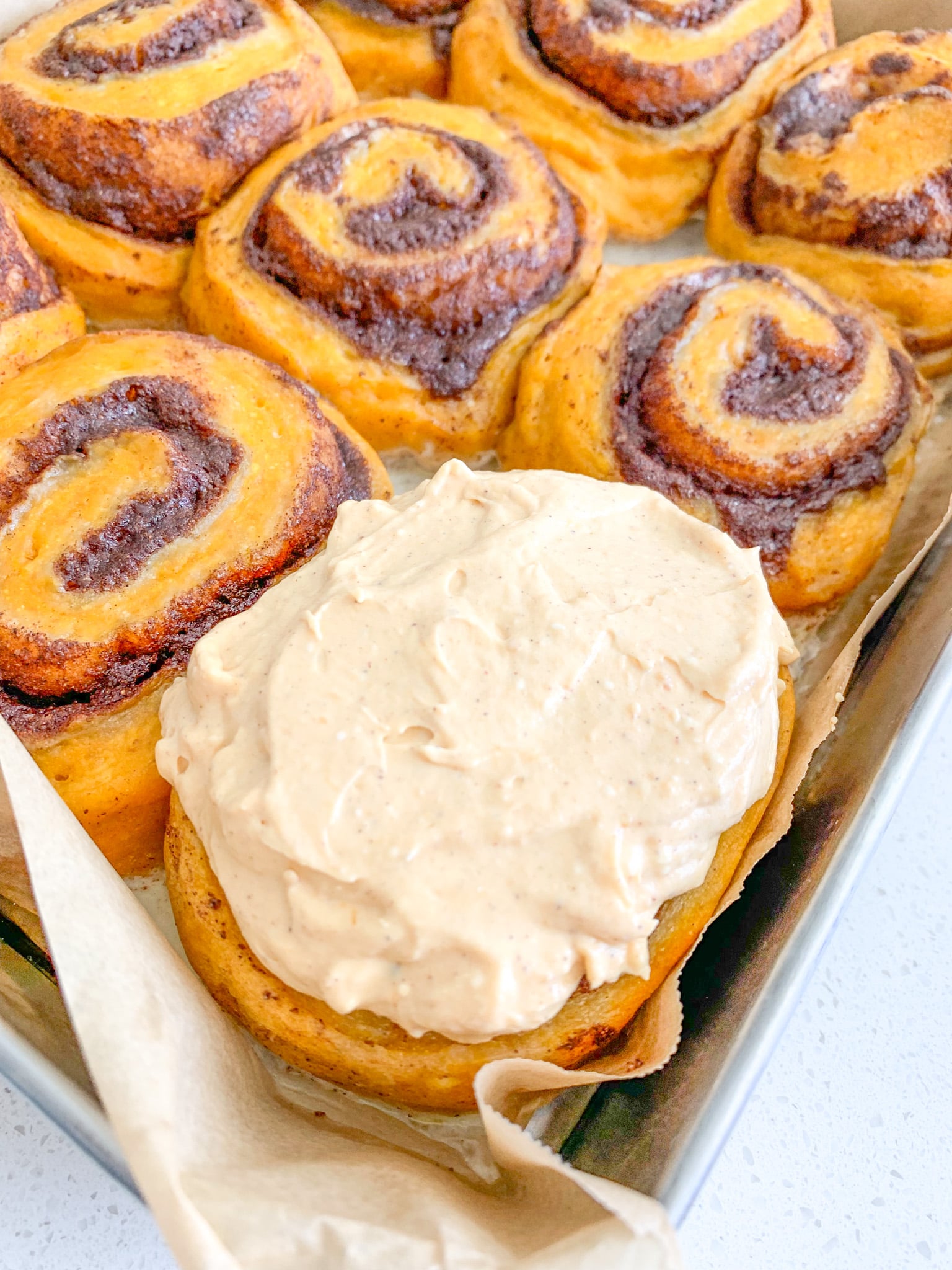
Sourdough Pumpkin Cinnamon Rolls
My sourdough pumpkin cinnamon rolls are so simple to make from scratch! They're soft and fluffy, full of homemade pumpkin spice flavor, and perfectly sweetened without being too much. My husband and I absolutely love the pumpkin maple cream cheese on top!
Ingredients
Instructions
Prepare Your Starter
- BEFORE YOU GET STARTED: If your starter isn't already fed and bubbly, feed it 4-12 hours before starting this recipe to ensure it's active. I recommend feeding it a 2:1 ratio of unbleached flour to filtered water to get the same results as I do when you make this recipe.Example 2:1 feeding: 1/2 cup flour + 1/4 cup water added to your entire starter jar (you can fill your jar up to half full, double this feeding or cut it in half depending on how much starter you want your jar). Let starter jar sit at room temperature until it's bubbly and has risen. Then measure out the amount of starter you need and begin this recipe!
Make the Dough
- Add flour, water, starter, sea salt, pumpkin, avocado oil, cinnamon, and nutmeg to a large bowl and mix until combined. Use your hands to bring dough together. Depending on your starter's hydration, which varies, the dough may be a little too dry so just add a couple tablespoons of water. If it's too wet, add a couple tablespoons of flour.
- Either knead the dough for 2-3 minutes by hand OR do the stretch-and-fold method (pick one).To do the stretch and folds, simply pull dough upward along the outside edge of the dough and fold it into the middle, do this all around the dough 1-2 times. Let dough sit for 10-15 minutes and repeat for a 2nd stretch and fold.
Bulk Ferment
- After kneading OR stretch-and-folding, place a damp kitchen towel, plastic wrap, or a lid loosely on the bowl. Let the dough sit at room temperature for 10-12 hours to bulk ferment. Please see notes below for troubleshooting.The dough needs to double or triple in size during this time. Depending on the time of year and temperature of your house, the time will vary. Add or subtract a few hours, if needed, until doubled or tripled in size.
Make Filling & Shape
- Preheat oven to 375 degrees Fahrenheit and line a 9x12” stainless steel baking pan with sides with parchment or lightly greased with butter and flour. Set aside.
- Make the filling by combining cane sugar, cinnamon, nutmeg, clove, and melted butter in a bowl until evenly combined. Set aside.
- Roll out dough on a lightly floured surface into a large rectangle approximately 10" x 20".
- With a butter knife evenly spread all of the filling over the entire rectangle, except leave about 1 inch of dough uncovered at one of the short ends so it's easy to seal after rolling.
- Starting at the shorter 10" side of the rectangle that has filling, begin to roll the dough into a log. Pinch the seam together with your hands and slice the log into 9, 2 inch cinnamon rolls.
Bake
- Arrange cinnamon rolls inside in 3 rows of 3, leaving space between each to expand (about 1/4” between). Tuck the tail (end of dough) under cinnamon rolls to ensure they don't unravel.
- At this time you can either continue the recipe or cover the baking sheet and pop them in the fridge until the morning or until you're ready to bake.
- Pour 1/4 cup milk over the tops of the cinnamon rolls and use a kitchen brush to coat evenly. Leave extra milk on the bottom of the pan around the cinnamon rolls.
- Bake for 23-25 minutes at 375 degrees Fahrenheit or until they are completely baked all the way through.
Make Frosting & Enjoy
- While they bake, make the frosting by adding softened cream cheese, maple syrup, milk, pumpkin, and cinnamon into a bowl. Mix with an electric mixer on low-medium speed until well combined. Store in the fridge until cinnamon rolls have cooled.
- Let cinnamon rolls cool at least 5 minutes, add frosting to the rolls you plan to eat, and enjoy!
Video
Notes
Store leftover cinnamon rolls unfrosted at room temperature for up to 3 days and the frosting in the fridge or frost the cinnamon rolls and store in the fridge for up to 5 days.
TROUBLESHOOTING HELP
Issue #1:
What to do if your dough isn't doubling in size during the bulk ferment and/or 2nd rise - If your dough doesn't look like it's doing anything halfway through either bulk ferment or 2nd rise, you need to place it in a slightly warmer area or give it a few more hours. This can be in a turned-off oven with the light on and oven door open, or you can slightly warm the oven to about 80 degrees Fahrenheit, then turn it off and place your dough inside with the door shut. Never leave the oven on, even on the keep warm setting, with fermenting dough inside.
Issue #2:
What to do if your dough won't double in size even in the warmer area (and your baked goods are dense) - If your dough doesn't double even in the warmer area for either the bulk ferment and/or the second rise, your starter is too weak to ferment the dough even in a warm environment. Don't worry this can be fixed!
To fix this, you will want to leave your starter out on the counter for 2 days and feed your entire starter jar every 12 hours at a 2:1 ratio of unbleached flour to filtered water (example: 1/2 cup unbleached flour + 1/4 cup filtered or bottled water, double this or cut it in half depending on how much starter you have, only fill your jar half full). Remove some starter before doing the feedings to make room if needed.
Make sure you're using unbleached flour and filtered or bottled water to do this. If you don't, it will affect your starter strength. Reverse osmosis water (or any water that uses salt in the filter) can make the starter weak.
By doing this feeding every 12 hours will strengthen the cultures in your starter for light and fluffy breads and treats. After the 2 days, you can go back to feeding it like normal. Be sure to use the 2:1 ratio feeding from here on out.
Sourdough Baking Disclaimer – I feed my sourdough starter a 2:1 ratio of unbleached flour to filtered water, this creates a 50% hydrated starter. If you feed your starter differently, results may vary.
Did you make this recipe? – If so, I’d be so grateful if you left a comment on the blog post!
A quick note: My recipes are created, tested, and loved in our home – never made with AI.
